
Many variables at once
People, machines, materials, time windows, inventory, capacity, priorities and risks must be weighed simultaneously.
INSIGHT · SCENARIOS · BETTER DECISION-MAKING
QuantaDutch helps organisations understand complex systems, calculate scenarios and make better-supported decisions. From operational planning and capacity challenges to strategic choices with many variables and uncertainties.
What we do
Many organisations already have data, dashboards and experience. Yet it often remains unclear where a problem truly originates, which decision creates the most impact and what happens when conditions change.
QuantaDutch helps make these relationships visible. We model processes, constraints and scenarios so decision-making becomes less dependent on assumptions and more grounded in structured insight.
Which challenges do we recognise?
QuantaDutch is relevant when planning, capacity, technology, resources and risks cannot be assessed in isolation.
People, machines, materials, time windows, inventory, capacity, priorities and risks must be weighed simultaneously.
A change in one place can affect planning, quality, costs, lead times or delivery reliability elsewhere in the system.
When scenarios contain too many combinations, it becomes difficult to support decisions quickly, robustly and clearly.
Organisations often face limits in scalability, calculation time, explainability or hidden dependencies.
Predictions are valuable, but decision-making also requires insight into relationships, constraints and system behaviour.
Translate complex systems into a clear model that makes scenarios, dependencies and decisions easier to discuss.
Our approach
QuantaDutch does not look only at individual variables, but at the relationships and dependencies that determine the behaviour of the overall system.
We translate processes, constraints, decisions and scenarios into a workable system view. This creates faster insight into where the real bottleneck is, which intervention is promising and which risks remain.
Applications
We focus on environments where capacity, planning, resources and dependencies determine performance and continuity.
Insight into where capacity actually gets constrained and which intervention creates the most effect.
Make dependencies between engineering, supply chain, production, quality and planning more visible.
Compare scenarios around routing, inventory flows, resources, planning and disruptions.
Model capacity, timing, demand patterns and constraints in relation to each other for better scenario analysis.
Develop testable software concepts, decision models and scalable platform logic around concrete challenges.
For whom
QuantaDutch is relevant for organisations where operational pressure, technical dependencies and strategic choices come together.
For decisions where technology, operations, risk, investment and long-term value come together.
For testing new models, software concepts and decision logic around concrete challenges.
For teams that work daily with capacity, processes, dependencies and disruptions.
For defined explorations in which practical value and technical feasibility are tested carefully.
Our story
QuantaDutch grew from a long-standing collaboration between technology, entrepreneurship and careful governance.
Some companies start with a business plan. QuantaDutch started from collaboration, curiosity and the conviction that complex systems can be better understood by looking at coherence rather than isolated parts.
The founders, John and Edwin, have known each other for more than twenty-five years. What began as a youth friendship developed into a collaboration in which technology, entrepreneurship and structure reinforce each other.
Over the years they discussed patterns, dependencies and optimisation challenges. The central question remained the same: how can complex choices be better understood and supported?
John has a strongly investigative way of thinking. His interest in patterns, history and underlying structures helped shape a technology approach focused on making hidden coherence visible.
This way of thinking has been translated into an independent optimisation and decision layer for complex planning, capacity and deployment challenges.
Edwin brings more than twenty years of experience from the financial sector. He worked closely with entrepreneurs and private clients and developed expertise in governance, financial structures, risk control, regulation and contractual frameworks.
That experience helps QuantaDutch operate not only with technical ambition, but also with care, reliability and organisational maturity.
Where John focuses on the technological core, Edwin safeguards the structure, stability and business development of the company.
To support careful decision-making and continuity, Jan fulfils a supervisory and advisory role within QuantaDutch.
QuantaDutch is therefore not a loose experiment, but a carefully built company with a clear long-term vision.
QuantaDutch develops and exploits software that makes complex real-world systems more understandable. The core lies in modelling variables, constraints, dependencies and scenarios.
For each application, we first clarify which problem truly needs to be understood or optimised. We then determine which input is required to deliver useful output: scenarios, optimisation results or better-supported decisions.
Our technology is intended to strengthen existing systems. The starting point is that partners and client organisations can retain their current software landscape, processes and interfaces as much as possible.
QuantaDutch adds additional modelling, calculation and optimisation capability in the background, creating value without unnecessary operational disruption.
QuantaDutch believes powerful technology must be applied carefully. Not to make systems more complex, but to help organisations make more explainable and responsible choices.
Optimisation only has real value when it contributes to understandable, testable and controllable decision-making.
That is why we prefer to focus on challenges where technical improvement also creates societal, operational or governance value.
For QuantaDutch, ethical use means that technology must not only work, but also fit the context in which it is applied.
QuantaDutch stands for depth over hype, structure over speed and collaboration over opportunism.
We deliberately choose controlled growth, qualitative validation and sustainable partnerships.
The legal structure, governance and technology protection have been carefully organised. QuantaDutch is ready to test its approach in the market with partners that value quality, reliability and continuity.
Pilot exploration
The first step does not need to be a large project. We prefer to explore one recognisable challenge with clear assumptions and a concrete question.
Approach
Our approach is phased and careful. First problem recognition, then deeper exploration, validation and possible pilot definition.
A 30 to 45 minute conversation about the challenge, the context and possible overlap with the QuantaDutch approach.
When relevance is clear, a follow-up conversation under NDA can address problem definition, domain context, data and potential validation.
When there is sufficient mutual trust, we define a small, testable pilot with scope, input, success criteria, confidentiality and ownership.
Our boundaries
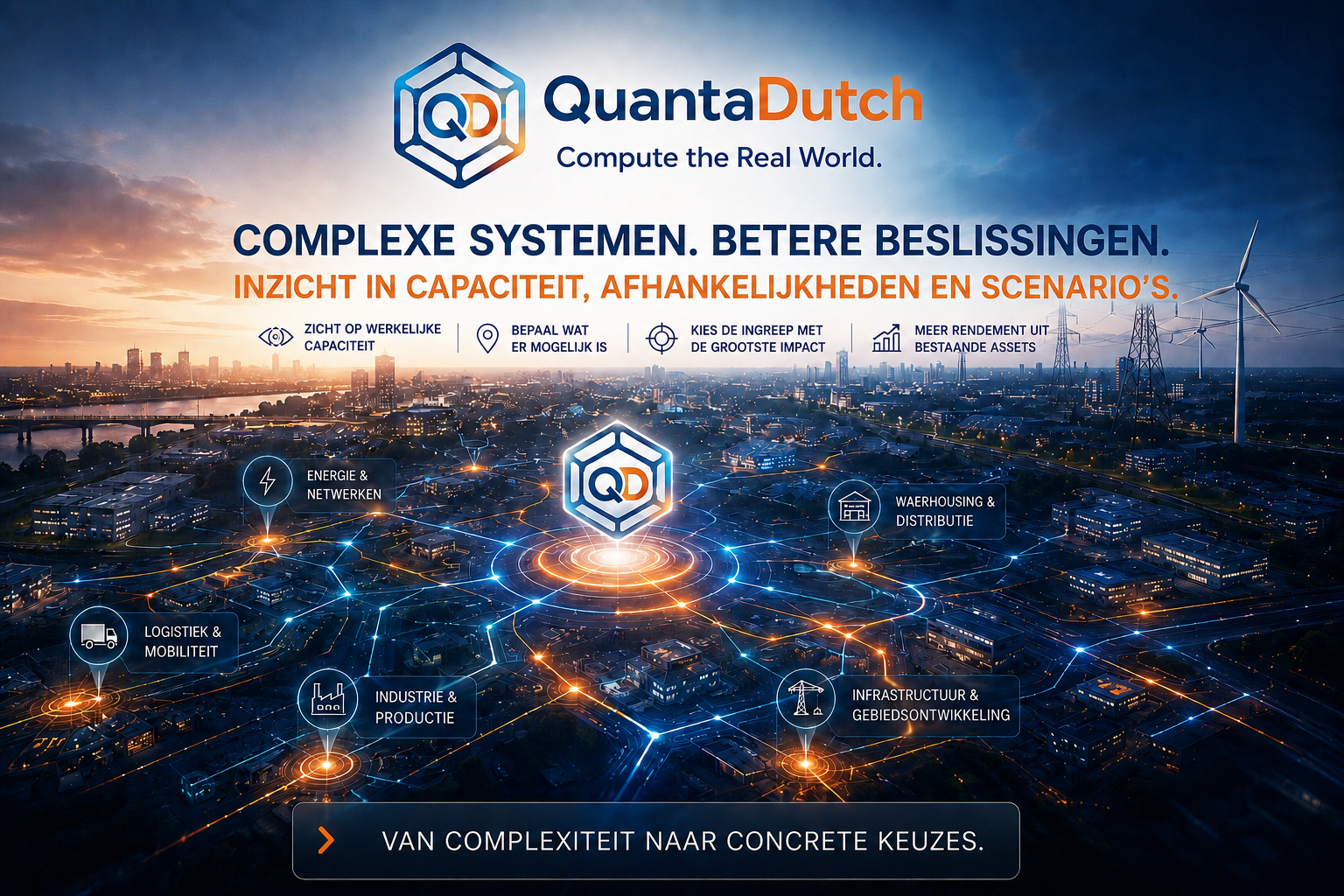
Visualisation
The visual reflects what QuantaDutch stands for: insight into capacity, dependencies and scenarios within real-world systems such as energy, logistics, industry and infrastructure.
For business updates, network development and strategic positioning.
View LinkedInFor visual explanation, concept development and longer deep-tech explorations.
View YouTubeGet in touch
Contact us for an initial substantive exploration. The goal is to determine whether modelling, scenario analysis or optimisation could create value in your situation.